Toray releases hybrid bonding insulating resin to enhance yields and reliability in high-density semiconductor packaging

Toray Industries, Inc., has developed an insulating resin material for hybrid bonding (micro bonding) based on its Semicofine™ and Photoneece™ materials. These are high-heat-resistant polyimide coatings for semiconductor and display devices.

The new material combines a conventional polyimide coating agent with the company’s processing and bonding technologies. It can enhance the yields and reliability of semiconductor devices in the hybrid bonding process, which entails bonding semiconductor chips with metal electrodes. Toray will push ahead with prototyping and providing samples to customers. It aims to obtain materials certification in 2025 and start mass production by 2028.


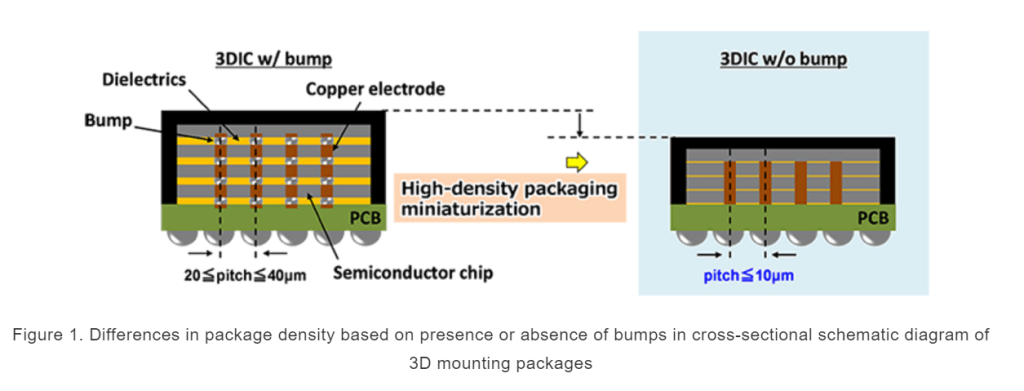
A leading high-performance packaging technology applied in recent years is three-dimensional (3D) packaging. This process involves vertically stacking semiconductor chips (see Figure 1). Hybrid bonding is particularly promising for high-performance semiconductor chips requiring fine structures with bump pitches (the spacing between adjacent electrodes joined by solder) of 10 microns or less. Toray markets resin bonding materials for 3D chip-to-chip packaging with fine bump pitches of about 20 microns. Hybrid bonding differs from conventional 3D packaging because it entails directly joining metal electrodes without using bumps, making it possible to further shorten electrode pitches.


Thanks!

You should receive an email from Jeremy@EVTechInsider.com

Can you check to make sure you received it? 


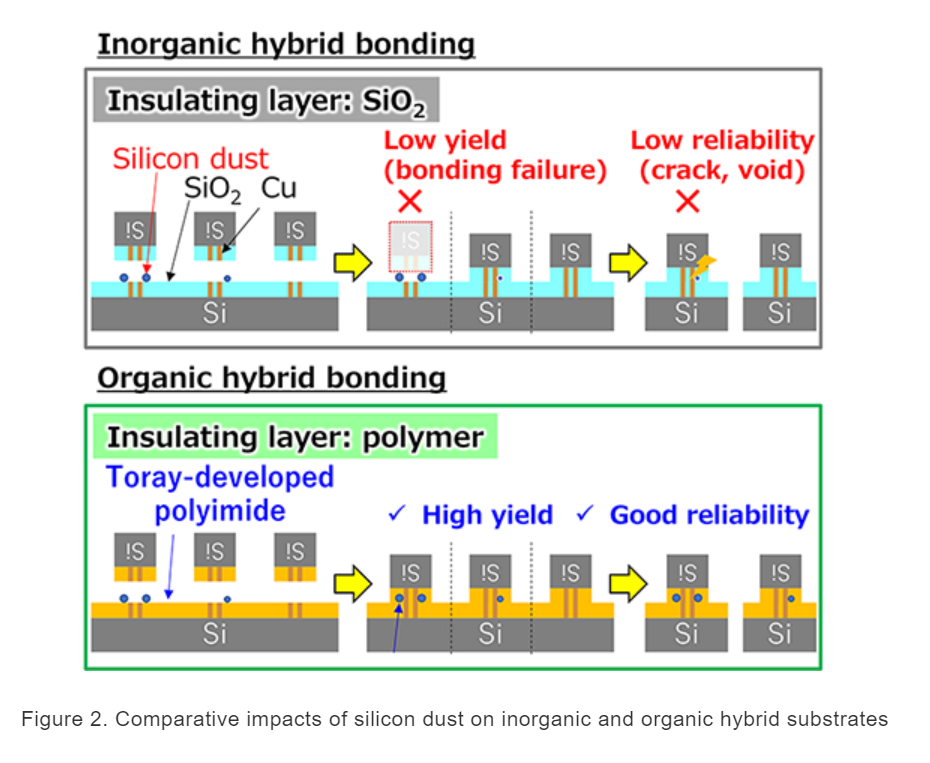
In hybrid bonding, the chip-to-wafer technique has attracted considerable attention for high-density packaging of different types of chips. This technique involves processing one wafer substrate to the chip size and bonding it to another wafer substrate. Silicon dioxide and other inorganic materials are usually used as insulating materials for hybrid bonding. There are two key challenges, however, with applying the chip-to-wafer technique. The first is that silicon dust generated in chip dicing can be trapped during hybrid bonding, causing chip bonding defects and lowering yields. The second is that trapped silicon dust threatens the reliability of semiconductor packages (Figure 2).
Since 2020, Toray reports it has carried out hybrid bonding experimental demonstrations with the Institute of Microelectronics, a semiconductor research unit of Singapore’s Agency for Science, Technology and Research. This work has tapped the company’s accumulated expertise in functional plastics design technology in employing sophisticated molecular design and pursues excellence to create insulating polymers offering high heat resistance and excellent mechanical properties (Figure 3). By collaborating with that entity and various semiconductor-related companies, Toray looks to apply this material to chip-to-wafer hybrid bonding. It seeks to boost the yields and reliability of chiplets and make it possible to integrate differing chips in a single package.

Toray will incorporate its new material in its lineup of resin products for semiconductor devices and electronic components with a view to fostering the adoption of high-performance next-generation semiconductor packages for high-speed communications devices and server applications. Toray will keep leveraging its core technologies of synthetic organic and polymer chemistry, biotechnology, and nanotechnology to innovate materials in keeping with its commitment to delivering new value and contributing to social progress.

Source

Get the latest ev tech news

Thanks!

You should receive an email from Jeremy@EVTechInsider.com

Can you check to make sure you received it? 

Thanks!

You should receive an email from Jeremy@EVTechInsider.com

Can you check to make sure you received it? 

If you enjoy learning about new EV technology like this, check out our EV whitepaper and webinar library here.

LEM launches SOC estimation sensor for EVs

LEM has announced the launch of its new Single Monitoring Unit (SMU) sensor family, designed to enhance the performance of Full Hybrid Electric Vehicles (FHEVs),

Read More »

New LEM sensor for accurate SOC estimation across all EV technologies

SMU sensor family provides designers of automotive battery management systems with a single solution for the needs of FHEV, PHEV and BEV technologies LEM (SIX:LEHN)

Read More »

Yokogawa to Release the Lightweight, Energy Efficient OpreX Battery Web Gauge ES-5 for the Production of Battery Electrode Sheets | Yokogawa America

Yokogawa Electric Corporation announces the development of the OpreX™ Battery Web Gauge ES-5, set to be released in January 2025 as part of the OpreX

Read More »

LEM launches SOC estimation sensor for EVs

LEM has announced the launch of its new Single Monitoring Unit (SMU) sensor family, designed to enhance the performance of Full Hybrid Electric Vehicles (FHEVs),

Read More »

Nissan to launch low-cost Vehicle to Grid technology in 2026

Nissan announced it will launch affordable on-board bi-directional charging on selected electric vehicles starting in 2026. The Vehicle to Grid (V2G) technology allows EV owners

Read More »

CATL launches its ‘Freevoy Super Hybrid Battery’ for EREVs and PHEVs

CATL has announced the launch of the Freevoy Super Hybrid Battery, a hybrid vehicle battery that reportedly achieves a pure electric range of over 400

Read More »

Lyten planning $1B lithium-sulfur battery gigafactory in Nevada, up to 10 GWh per year

Lyten plans to invest over $1 billion to build the world’s first Lithium-Sulfur battery gigafactory. The facility will be located near Reno, Nevada, with the

Read More »

General Motors is planning a $145M battery cell prototype center in Warren, MI

General Motors plans to build a $145 million battery cell prototype center at its Global Technical Center campus in Warren, construction is expected to begin

Read More »

Bel Fuse launches 4kW liquid-cooled DC-DC converter for rugged EVs

Bel Fuse Inc announced the launch of the 350DNG40-12-8, a 2nd generation 4 kW liquid-cooled DC-DC converter. This converter operates from 240 to 450 VDC

Read More »

Forge Nano nabs $10M investment from GM to enhance battery cathode materials

Forge Nano announced a $10M investment from GM Ventures, adding to its recent $50 million Series C, which included participation from Hanwha, Orion Infrastructure Capital,

Read More »

Form Energy nabs $150M from DOE for its West Virginia battery plant

The U.S. Department of Energy’s Office of Manufacturing and Energy Supply Chains has selected Form Energy for an award of up to $150 million under

Read More »

KORE Power nabs conditional commitment for $850M from DOE for its battery factory in Arizona, production planned for 2024/2025

KORE Power, Inc. (KORE) has received a conditional commitment from the U.S. Department of Energy’s Loan Programs Office (LPO) for a loan in the principal

Read More »

LEM launches SOC estimation sensor for EVs

LEM has announced the launch of its new Single Monitoring Unit (SMU) sensor family, designed to enhance the performance of Full Hybrid Electric Vehicles (FHEVs),

Read More »

New LEM sensor for accurate SOC estimation across all EV technologies

SMU sensor family provides designers of automotive battery management systems with a single solution for the needs of FHEV, PHEV and BEV technologies LEM (SIX:LEHN)

Read More »

Yokogawa to Release the Lightweight, Energy Efficient OpreX Battery Web Gauge ES-5 for the Production of Battery Electrode Sheets | Yokogawa America

Yokogawa Electric Corporation announces the development of the OpreX™ Battery Web Gauge ES-5, set to be released in January 2025 as part of the OpreX

Read More »

LEM launches SOC estimation sensor for EVs

LEM has announced the launch of its new Single Monitoring Unit (SMU) sensor family, designed to enhance the performance of Full Hybrid Electric Vehicles (FHEVs),

Read More »

Nissan to launch low-cost Vehicle to Grid technology in 2026

Nissan announced it will launch affordable on-board bi-directional charging on selected electric vehicles starting in 2026. The Vehicle to Grid (V2G) technology allows EV owners

Read More »

CATL launches its ‘Freevoy Super Hybrid Battery’ for EREVs and PHEVs

CATL has announced the launch of the Freevoy Super Hybrid Battery, a hybrid vehicle battery that reportedly achieves a pure electric range of over 400

Read More »

Lyten planning $1B lithium-sulfur battery gigafactory in Nevada, up to 10 GWh per year

Lyten plans to invest over $1 billion to build the world’s first Lithium-Sulfur battery gigafactory. The facility will be located near Reno, Nevada, with the

Read More »

General Motors is planning a $145M battery cell prototype center in Warren, MI

General Motors plans to build a $145 million battery cell prototype center at its Global Technical Center campus in Warren, construction is expected to begin

Read More »

Bel Fuse launches 4kW liquid-cooled DC-DC converter for rugged EVs

Bel Fuse Inc announced the launch of the 350DNG40-12-8, a 2nd generation 4 kW liquid-cooled DC-DC converter. This converter operates from 240 to 450 VDC

Read More »

Forge Nano nabs $10M investment from GM to enhance battery cathode materials

Forge Nano announced a $10M investment from GM Ventures, adding to its recent $50 million Series C, which included participation from Hanwha, Orion Infrastructure Capital,

Read More »

Form Energy nabs $150M from DOE for its West Virginia battery plant

The U.S. Department of Energy’s Office of Manufacturing and Energy Supply Chains has selected Form Energy for an award of up to $150 million under

Read More »

KORE Power nabs conditional commitment for $850M from DOE for its battery factory in Arizona, production planned for 2024/2025

KORE Power, Inc. (KORE) has received a conditional commitment from the U.S. Department of Energy’s Loan Programs Office (LPO) for a loan in the principal

Read More »