The World Bank reports that in 2020, the global mining industry used about 2.5 million terajoules of energy, approximately 6% of the world’s energy use. Electrifying off-highway equipment has the potential to significantly reduce this, and China’s already ahead (again).
In a recent analysis of battery-powered mining equipment, China dominates with 60.5% of the world’s total deployments, mostly supplied by Chinese OEMs Yutong and Sany. The US is catching on though. North America’s off-highway electric vehicle market size is expected to reach $10.1 Billion by 2032 and to get there, off-highway OEMs have a steep grade ahead.

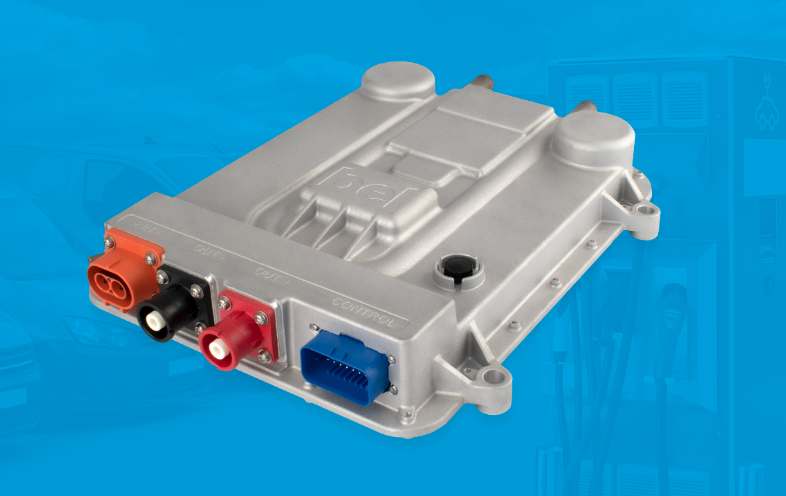
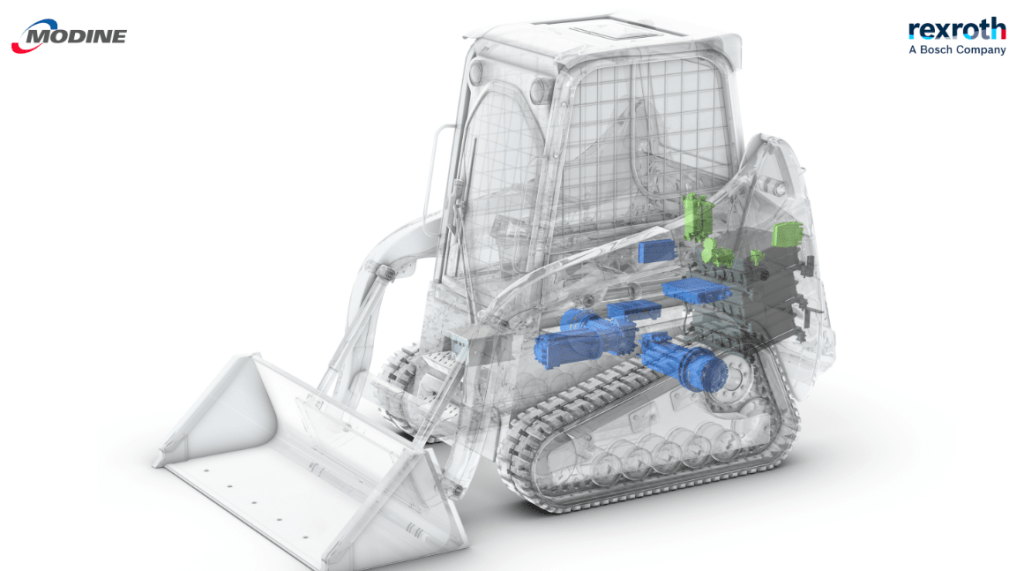
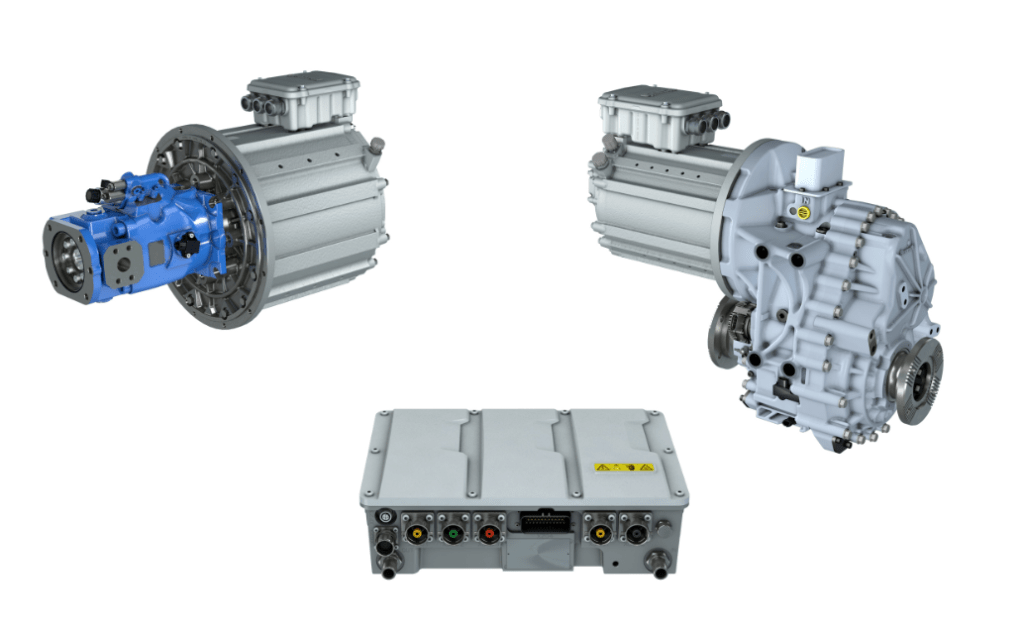
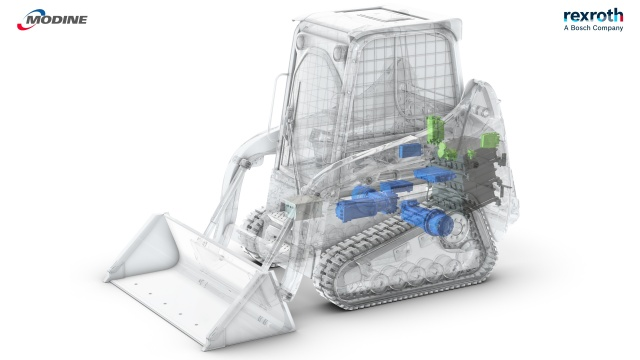
Rexroth, a Bosch company, manufactures electric off-highway powertrains. Its eLION portfolio consists of a permanent magnet synchronous electric motor, electric inverter, onboard charger, DC-DC converter, power distribution unit, high voltage cables with plugs, and a controller. But, with high-power equipment comes a familiar foe: heat.

To combat this, they’ve collaborated with leading thermal management manufacturer Modine Manufacturing to tailor EVantage Thermal Management Systems for electric off-highway equipment, and together they’re helping OEMs streamline the transition while keeping their cool.
Challenges ahead:
Off-highway OEMs are facing several unfamiliar challenges:
- How do battery-powered systems work?
- How do we architect the powertrain?
- How can we maintain the long-term integrity of these expensive systems?
- How do we get operator buy-in?
- How can we ensure the reliability of these systems in harsh, dirty environments?
Of those, the architecture is particularly challenging. It’s a new territory, and engineers are working to fit large power electronics, battery packs, electric motors, and accompanying thermal management components within a tight envelope.
This challenge is accentuated with off-highway equipment due to high power and extreme use, and unlike on-highway vehicles, there’s significant variation in vehicle lineups. In one mine, you may have small 5-person people movers, skid steers, excavators, and 100-ton dump trucks, each with varying use cases, power requirements, and operating times. Furthermore, with incoming regulatory and Chinese pressure, OEMs are under time-to-market constraints and may feel backed into a corner.
Enter Modine’s EVantage Thermal Management System:
Modine’s commercial electric vehicle cooling system has been used for several years in commercial on-highway vehicles. It uses both liquid and air-cooled passive thermal management, and now it’s been re-engineered and optimized for Rexroth’s eLION off-highway portfolio.
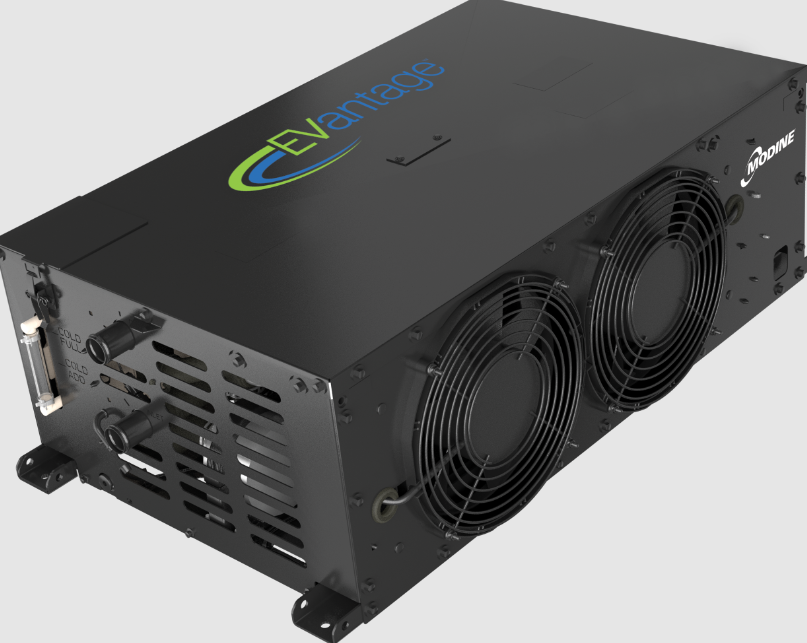
“We optimized EVantage for architectures around 700 volts. That’s going to be your vehicles with approximately 400-800 horsepower, like skid steer loaders, backhoe loaders, all the way up to large front-end excavators. Modine provides the complete system for these machines, which independently cools the electronics, batteries, passenger cabin, and hydraulic systems (since most of today’s machines are still running hydraulics).” – Jeremy Shiflett, Modine
Cooling power electronics is simple:
“The majority of the time, we use passive air-cooling for power electronics. This is a radiator like you’d see on a diesel engine today. We’ve worked closely with Rexroth’s electronics engineers to guide us on optimal operating temperature.
During operation, the electronics can heat up to about 60-90°C/140-194°F, and the passive system cools them down to an ambient temperature of around 45°C/113°F. If you fail to keep them in this range, the electronics may derate themselves.” says Jeremy.
Cooling batteries and passengers is more complicated:
“On the other hand, battery and passenger thermal systems require both passive and active cooling. Instead of a blanket approach, the system has multiple modes to optimize power consumption.” This is important for many reasons, namely:
- Heating and cooling require energy, and that energy isn’t free. Especially at scale, decreasing energy costs has a positive ripple effect on the entire supply chain, that’s key.
- Unlike traditional diesel machines which are happy to operate at a wide range of temperatures, electric vehicle batteries (and power electronics) have a thermal ‘sweet spot’ during operation. Higher temperatures degrade batteries which harms the long-term health and thus resale value of the vehicles.
- As the entire world learned from the Arctic Blast of 2023, at frigid temperatures the packs won’t accept a charge. Battery packs need to slightly heat themselves (precondition) before they can be charged.
“At normal temperature (around 15°C/59°F), the system will simply run the radiator as passive cooling. During the day as the machines heat up and temperatures increase to around 25°C/77°F, the active cooling mode activates and the compressor kicks on, but at a limited speed. Just enough to match the current thermal conditions.
During heavy operation when the machine approaches 35 degrees C, the compressor will ramp up to full speed, and a battery pack must maintain an optimal temperature range of 20o to 45oC regardless of ambient temperature.
Preconditioning:
Most battery chemistries won’t even accept a charge in freezing temperatures. When it’s below 0°C/32°F, the heating mode is activated, which preconditions the battery pack temperature so it may begin charging. The advanced system calculates when the shift will begin, how much charge is needed, and thus what temperature the pack needs to be preconditioned to.
“It’s important to engineer the system so it doesn’t overshoot the target. If you precondition the pack too much, you degrade the cells. Charging by itself also naturally creates heat, so we’ve outfitted the system with sensors that tell the preconditioning to back off and keep the pack in the optimal range.” – Jeremy Shiflett
Preconditioning strategy is an entirely new practice that operators are learning. There is an upside, workers are happy that the cabin can also be ‘preconditioned’. Instead of spending the first 30 minutes cranky in a loud frozen machine, the cabin is warm and toasty when they arrive.
What are some of the other advantages for mining operators to go electric?
“Diesel engines emit nasty fumes, and mining operators are under strict occupational regulations to keep those emissions down. It’s very expensive to outfit a mine with emission-clearing equipment, while electric vehicles eliminate the problem at the source. Not only does this save your workers’ lungs, but cuts down costs and streamlines operations.” – Enrique Busquets, Rexroth
There are also regulations including functional safety and explosion-proof standards that OEMs must follow. Rexroth and Modine say that the components and thermal systems have been designed and validated in line with the most stringent European regulations.
Rexroth and Modine have dedicated labs to validate their technology, reporting that the components are rated for very harsh shock and vibration resistance. For instance, the electronic controllers and thermal management systems are rated for 50 Gs, which is extremely high. They put the components through pressure cycle, vibration, and climate chamber testing to make sure they safely function in various conditions. Both of the companies bring deep experience in vehicle system design and manufacturing, which is why OEMs have trusted them for decades.
Speaking of feedback, what else are you hearing?
“With all change comes hesitancy.
Operators tell us they like their diesel machines, but once they give it a chance they turn around. Workers wear stiff bulky earmuffs to protect their hearing, and their ears thank them when they realize how much power can be delivered so quietly, and without the vibration. They also say great things about the rapid acceleration and deceleration without braking, on top of the equipment’s overall ease of use and efficiency.
I’ve used the machines myself and it feels like magic flipping a switch to power it on and off versus cranking up a loud diesel engine and seeing that exhaust plume. When the day is done and it’s time to go home, they’re surprised to see the vehicle still has charge left.
In my opinion, the overall controllability and simplicity of electric equipment is far superior.” – Jeremy Shiflett
“These electric machines are still in their first phase. As we increase rollouts and find new applications, we keep discovering new advantages for mining operators.
To be fair, there are always compromises, but if you zoom out to the big picture, operators find that the positives far exceed the negatives. Once we get over that initial hump, the comfort, efficiency, and ease of use become things that they can’t live without.
The trick is how do you design equipment that outperforms diesel guzzlers in as many ways as possible, and optimizing the energy consumption via thermal management is a huge component to that.” – Enrique Busquets
What is coming down the pipeline from Modine?
Over the next 12-24 months, the next generation of EVantage Thermal Management Systems will be released, and that will really take off-highway equipment to the next level. One thing I can tease is our heat recovery systems which will maximize the performance while minimizing energy consumption and the number of components.” – Jeremy Shiflett
What is coming down the pipeline from Rexroth?
Rexroth sees the off-highway market as a huge opportunity to learn and grow as a company, including intensive collaborations with companies like Ymer, Webasto, Wolfle, Eberspacher, and Modine. These companies are laser-focused on system-level innovation, especially on the software side because there is always room for more optimization, which goes hand-in-hand with the thermal management system.
“The eLION portfolio started with just electric motors, and now it’s a very comprehensive lineup with motors, inverters, onboard chargers, DC-DC converters, and cables. Now that we’ve complemented that portfolio with the help of Modine, we offer essentially anything that OEMs need, with the exception of the battery cells.” – Enrique Busquets