We recently had the opportunity to speak with Mukesh Patel, Chief Engineer at Evolito, who provided us with an insider’s look at how the company is leveraging axial-flux technology for electric aircraft.
Can you walk us through the background of Evolito?

In 2021, Evolito spun out of automotive axial-flux pioneer YASA Motors to commercialize next-generation electric propulsion tech for the aerospace industry.


The spinoff gave us an ecosystem that sets us apart from other aerospace suppliers. It’s easy to create a super high-performing prototype as a one-off or a two-off. They may be handcrafted with the best materials, tightest air gaps, etc. with validation showing the highest flux density available on the market. That’s a great exhibition, but when you move to mass production, you have to account for variations in material property, tolerancing, etc, and suddenly the machines don’t carry the same high performance, sometimes 10-15% less than expectations.
This is one of Evolito’s biggest strengths. Not only did the spinoff give us decades of investment and experience to develop high-performance axial-flux motors and controllers, but also industrialization expertise to bring that to market.
Going back 10-15 years, it’s well-known that YASA’s motors have long been suitable for aerospace applications, but the market wasn’t ready because the power sources and aircraft electrical architectures were not mature enough. Now that technology has caught up, we are finally able to apply it. The motor tech isn’t new, in fact, it’s quite mature, and we’re able to achieve that very quickly with the YASA background.
What are the differences between electric aerospace and automotive design requirements?
There are some differences, especially with respect to safety.
Design assurance and traceability become mission-critical in aerospace. For example, for all of our metal housings, we have pinpoint accurate traceability back to the mill. We do this for every single component and maintain the highest level of quality control with everything we manufacture.
The design process also requires a lot more control. Often, automotive engineers switch to aerospace, and find it difficult to deal with the extra layers of review processes… but everything needs to be triple checked and also follow aerospace-recommended practices. These guidelines have been refined over many decades due to aircraft failures, and we need to implement those to the most stringent level to even stand a chance for certification.
It’s never good enough to say ‘Here are a couple of requirements, we’ve tested it and we pretty much meet them’. We require vigorous effort to demonstrate that the fundamental requirements are met and the product is able to perform fully at normal and in extreme scenarios when the product is new and at the end of its life.
You will struggle to find another aerospace supplier who takes this as seriously as Evolito, along with their commitment to creating the highest performing products to enable more efficient flight.
Another important piece of the puzzle is cost-effectiveness. It’s a little less sensitive than automotive, where OEMs beat you up over a single penny. Instead, safety takes center stage.
Even with high-volume aircraft like the A320, it’s still relatively low compared to passenger vehicles. However, Evolito has achieved compatibility between safety and cost-effectiveness, which ultimately comes down to intelligent design and industrialization experience. The YASA background has helped us tremendously in this aspect, again, it’s nothing new for us.
We don’t consider a design valid and ready for market until it’s ready for high-volume production at the right cost. It’s in our DNA. Several of our engineers have over 20 years of experience in aerospace, and they bring deep relationships within the supply chain. During the design phase, one of the primary goals is to simplify the components, which not only lowers costs but also makes it safer because the simpler the piece, the less chance of failure. We’ve found that low cost and safety can actually go hand in hand.
Controller design:
While piloting an aircraft, oftentimes you are faced with highly transient conditions and situations, which makes it unique when compared to passenger vehicles. Our motor controllers are on par with the best in class in automotive and aerospace, with additional functionality than your typical controller.

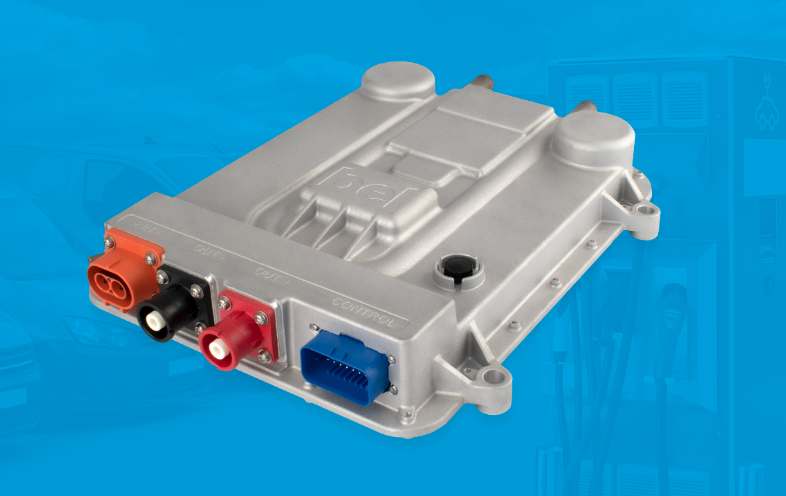
At a macro level, the controller is essentially two parts: an inverter and a controller. It contains all of the monitoring systems and logic to measure the state of the motor based on the operating conditions. It regulates the machine to ensure it’s achieving exactly what it’s being asked to do.
The inverter modifies the power supply, allowing you to control the speed of the machine. The controller takes commands from the aircraft, managing the motor frequency. It’s critical that the architecture and control logic are designed in a very rigorously tested, math-oriented way, not only to ensure safety during a fault scenario but also to not alarm passengers onboard, and safely land the aircraft if needed.
The controller continuously measures and monitors the rotation to maintain safety and stability for as long as possible. If a motor fails on a passenger vehicle, you simply pull off to the side of the road. Aircrafts don’t get that luxury, so the controllers require rock-solid design assurance, tested against a multitude of failure conditions. In our validation lab, we’ve covered all the failure conditions possible. Most of these are fact-based, mathematically devised conditions from our experience in the industry, but we also add a lot of imagination to push the boundaries further. We experiment with novel situations to ensure the highest level of safety so there aren’t any surprises.
The software in the inverter is programmed with all of the logic needed to react to various failure modes, ensuring rotation irrespective of various failure modes. For example, if one of the propellers on a multi-propellor craft goes down, the control system needs to redistribute the thrust to maintain flight. It will increase thrust in some areas while decreasing in others to maintain balance. This becomes even more important in nasty conditions such as hovering at high gusts, which want to flip the aircraft over.
At altitude, conditions changes, and the aircraft needs to be designed around that. We also work to higher levels of creepage and clearance because of this. As altitude increases, the separation distance between high voltage components needs to increase because there is less air than on ground level. As altitude increases, the air density decreases, which in turn reduces the insulating capability of the air. This means larger separation distances are needed between high voltage components to prevent electrical discharge. To make sure everything works safely, we adhere to rigorous design standards that specify different levels of insulation and isolation depending on the operational altitude. This ensures the safe and reliable performance of our electrical systems in all environmental conditions.
Advantages of axial-flux motors:
To give a quick introduction to axial-flux motors, basically, it’s marked with magnetic fields aligned along the axis of rotation. In your traditional radial-flux motor, you have the radial cylinder, and the magnetic flux comes out in a radial direction, interacting with an electromagnet on the outer diameter. In an axial-flux machine, the field is aligned with the axis of rotation, so if the rotation is along the axis and you’re spinning around that axis, the magnetic field is in the same direction as the axis. We do that by arranging the magnets and coils in a 90-degree direction.
On the axial-flux machine, the rotor is actually a disc, resembling a brake disc. The magnets are on the outer diameter of that disc, and that’s what creates the magnetic flux to go in an axial direction. This configuration allows for more efficient use of magnetic flux. Compared to a radial machine, it reduces power losses and improves overall efficiency.
We use novel materials in the axial-flux machines, different from what’s found in a typical radial machine. These materials have much higher magnetic density and allow us to achieve higher torque and power densities compared to radial flux.
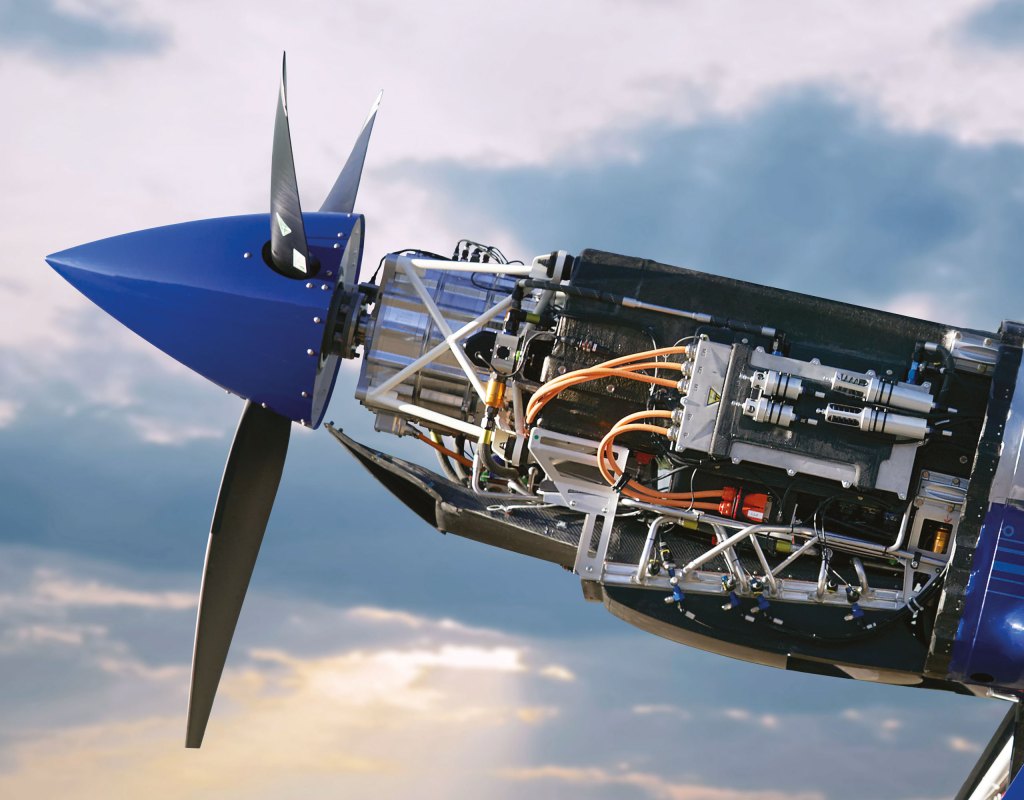
Also, radial-flux machines are typically about three times the size for a given power or torque density compared to axial flux. Decreased size and higher efficiencies are an even bigger deal for aerospace applications, and with this technology, you gain a lot of design freedom to either size the powertrain down or increase the range via a larger pack size. For instance, in a single prop aircraft, there’s a large nose cone in the front for an engine, which can now be reduced. They’re also lighter, maximizing the power-to-weight ratio.
The best radial machines available achieve around seven kilowatts per kilogram in production, while Evolito’s production-proven machines are above twenty kilowatts per kilogram, we’re significantly better than what’s available on the market today.
The machines and inverters are both oil-cooled, which allows us to reach the high power density at peak conditions either continuously or much longer than a traditional air-cooled motor. Oil-cooled radial machines have difficulty cooling. Due to the geometry, the oil doesn’t reach deep inside the slots. Our axial-flux machines are fully immersed in oil, which gives us great direct cooling.
On top of that, the electrical insulation is much more robust, adding a lot more fault tolerance. Radial machines have coils wound on top of each other, and if there’s ever a short between the two and weakness in the insulation, you get a turn-to-turn short, which is a really bad day. They can fail violently if shorts occur in the wrong location. In our axial flux machines, the cooling also insulates the faults, adding to the safety.
Finally, we have one-by-three or two-by-three phase configurations. Your average electric machine is typically three phase, and you need all three for it to function. If one of those phases goes down, you end up with decreased performance, and you must shut the machine down as you encounter a fault. We’ve developed true redundancy with a two-by-three phase, powered by dual controllers. We can design the machine so that if one lane goes down, we take it down, and still offer full performance with the fully redundant lane, all in the same package and size. We also offer full mechanical and physical segregation, so you don’t have two windings next to each other without barriers. We offer all this in a space and mass-efficient package, much better than your typical radial-flux machine.
What sort of volume are you anticipating?
The volume is always dictated by the customer. Airframes are still developing their prototypes, and we’re helping them along the way. There are several companies entering or pivoting to electric and hybrid, many planning to launch services around 2027. We anticipate their certification will take about 18 months, which means they’ll begin preparing around the end of 2025, at which point we’ll ramp up production. If the forecasts are right, we’re looking at tens of thousands of units, once fleets are fully in service.
Special thanks to Mukesh Patel for the interview!