Challenges of Designing Electric Mining Vehicles’ Power Electronics

  • Explosion protection, extreme torque, difficult terrains, and high power pose a new challenge for off-highway vehicle manufacturers, and China is one step ahead of the West.
  • HummingbirdEV manufactures heavy-duty EV power for Keshi Group’s mining vehicles in China, read this interview with the co-founder Vinay Jayachand to hear about their challenges along the way.

Can you give us an introduction to HummingbirdEV?

HummingbirdEV started in 2015, aiming to vertically integrate powertrain components for medium and heavy-duty OEMs. Our first customer was in the mining industry, which posed a unique set of challenges, for example:


Thanks!

You should receive an email from Jeremy@EVTechInsider.com

Can you check to make sure you received it? 

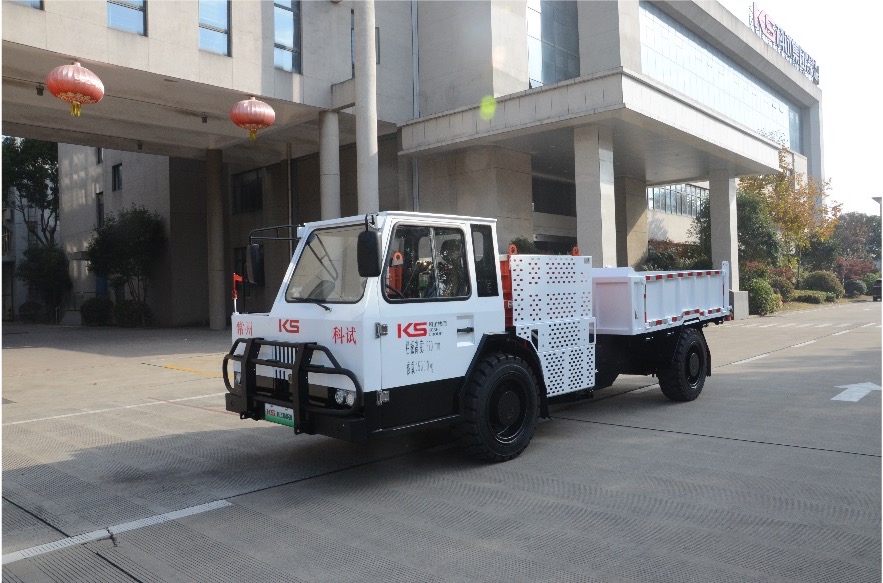
Challenge #1 – Mining vehicles are very diverse. People movers, dump trucks, excavators, etc. all have varying requirements and functions. Within the vehicle types, they branch out with even more diversity. Some people movers may have 5 seats, some with 16, load carriers can range from 5-12 tons, etc. There are several vehicles in a mining operation with varying gross vehicle weight (GVW) and payload capacities. 

The goal was to develop a modular architecture that allows the reuse of components in both low and high-class vehicles to save cost. 

Challenge #2 – The power required is nothing like passenger vehicles. They have astronomical power take-off (PTO) needs, a wide range of peak power, and operate with hydraulic power. For instance, a 9 or 12-ton load carrier has peak power levels around 250-300 kilowatts, and they need to operate between 12-18 hours. That’s pretty high utilization, unlike a passenger car which is frequently idle.

It’s integral to understand how long they need to operate, at what power levels, etc., and design the powertrain accordingly, along with accompanying infrastructure.

Challenge #3 – They need to be safe and outperform their diesel counterparts. China, so far the world leader in mining electrification, has strict requirements on vehicles such as explosion protection. 

Years ago, the performance of our prototype systems caught the attention of Chinese off-highway manufacturer Keshi Group, and today our power electronics are in about 400-500 Keshi vehicles in Chinese mines. 

How did this relationship begin? 

Initially, we were retrofitting Keshi Group combustion chassis designs by integrating packs, motors, transmissions, etc. The traction by itself was fine, but when it came to auxiliary power, you ran into issues when switching from a belt-driven system to an electric one, so we tore it down to begin a ground-up electric design. 

We developed inverters, bi-directional chargers, power distribution units, etc., with accompanying software. Keshi handles its battery module sourcing, cell-to-pack battery packaging, electric motor design, and integration into explosion-proof enclosures. Regulations prevent you from putting the electronics and cells together in one compartment, so we worked closely with them for the competent placement of the powertrain components as well. 

HummingbirdEV provides AC charging stations, compatible with both single and three-phase power. Along with our onboard charger, we can provide up to 40-60 kilowatts of charging power from the grid. Mining operators tend to have a mixture of DC and AC chargers on-site, depending on the level of infrastructure investment they prefer.

What are some of the advantages for mine operators to go electric?

Companies are just now waking up to the several potential benefits, a lot of which we’ve learned from China. 

Protection: 

Diesel emissions are harmful to the environment, of course, but they’re even worse in a closed-off environment such as deep inside a mine. It’s a health hazard for the workers, and electrification can eliminate this. 

Drive cycles and cost:

These machines are high-torque, low-speed, very repeatable, and predictable, which is a perfect fit for electrification. 

Diesel prices fluctuate, adding unknown cost variables to the operation. Grid energy costs tend to be more stable, and you can even offset that if you implement solar panels and bi-directional charging. 

Lastly, combustion engines are full of moving parts, which equates to more machine servicing. Electric powertrains have much fewer moving pieces and tend to have a longer operating life requiring less maintenance. 

Economically, it makes sense to go electric. 
What does that initial deployment look like? I imagine a big switch isn’t easy…

The initial deployments are always the most challenging, everybody has upskilling to do, which is difficult. 

The operators need to educate workers on how electric powertrains function. For instance, the power is completely different, and previous high-voltage systems took up to 30 seconds to start, while diesel systems started instantly.  

Keshi recognized this early on, and they offer services with the vehicles for staff training. They deploy Keshi drivers on-site who teach operators about fault code reporting, how the battery systems work, how the inverters work, what to do when things go wrong, what to expect, etc. This has helped smooth things out, and they’ve found once the staff becomes knowledgeable, they wake up to the EV advantages. The feedback has been excellent so far, and it’s quickly spreading.

How long until you think we’re all electric in North America?

The market is getting aggressive, you have all of the main players in North America pushing for electrification in all aspects of off-highway, and I think by 2035, or worst case scenario 2050 we’ll have fully electric mining operations.  

Special thanks to Vinay Jayachand
Get the latest ev tech news

Thanks!

You should receive an email from Jeremy@EVTechInsider.com

Can you check to make sure you received it? 

If you enjoy learning about new EV technology like this, check out our EV whitepaper and webinar library here.

LEM launches SOC estimation sensor for EVs

LEM has announced the launch of its new Single Monitoring Unit (SMU) sensor family, designed to enhance the performance of Full Hybrid Electric Vehicles (FHEVs),

Read More »

New LEM sensor for accurate SOC estimation across all EV technologies

SMU sensor family provides designers of automotive battery management systems with a single solution for the needs of FHEV, PHEV and BEV technologies LEM (SIX:LEHN)

Read More »

Yokogawa to Release the Lightweight, Energy Efficient OpreX Battery Web Gauge ES-5 for the Production of Battery Electrode Sheets | Yokogawa America

Yokogawa Electric Corporation announces the development of the OpreX™ Battery Web Gauge ES-5, set to be released in January 2025 as part of the OpreX

Read More »

LEM launches SOC estimation sensor for EVs

LEM has announced the launch of its new Single Monitoring Unit (SMU) sensor family, designed to enhance the performance of Full Hybrid Electric Vehicles (FHEVs),

Read More »

Nissan to launch low-cost Vehicle to Grid technology in 2026

Nissan announced it will launch affordable on-board bi-directional charging on selected electric vehicles starting in 2026. The Vehicle to Grid (V2G) technology allows EV owners

Read More »

CATL launches its ‘Freevoy Super Hybrid Battery’ for EREVs and PHEVs

CATL has announced the launch of the Freevoy Super Hybrid Battery, a hybrid vehicle battery that reportedly achieves a pure electric range of over 400

Read More »

Lyten planning $1B lithium-sulfur battery gigafactory in Nevada, up to 10 GWh per year

Lyten plans to invest over $1 billion to build the world’s first Lithium-Sulfur battery gigafactory. The facility will be located near Reno, Nevada, with the

Read More »

General Motors is planning a $145M battery cell prototype center in Warren, MI

General Motors plans to build a $145 million battery cell prototype center at its Global Technical Center campus in Warren, construction is expected to begin

Read More »

Bel Fuse launches 4kW liquid-cooled DC-DC converter for rugged EVs

Bel Fuse Inc announced the launch of the 350DNG40-12-8, a 2nd generation 4 kW liquid-cooled DC-DC converter. This converter operates from 240 to 450 VDC

Read More »

Forge Nano nabs $10M investment from GM to enhance battery cathode materials

Forge Nano announced a $10M investment from GM Ventures, adding to its recent $50 million Series C, which included participation from Hanwha, Orion Infrastructure Capital,

Read More »

Form Energy nabs $150M from DOE for its West Virginia battery plant

The U.S. Department of Energy’s Office of Manufacturing and Energy Supply Chains has selected Form Energy for an award of up to $150 million under

Read More »

KORE Power nabs conditional commitment for $850M from DOE for its battery factory in Arizona, production planned for 2024/2025

KORE Power, Inc. (KORE) has received a conditional commitment from the U.S. Department of Energy’s Loan Programs Office (LPO) for a loan in the principal

Read More »

LEM launches SOC estimation sensor for EVs

LEM has announced the launch of its new Single Monitoring Unit (SMU) sensor family, designed to enhance the performance of Full Hybrid Electric Vehicles (FHEVs),

Read More »

New LEM sensor for accurate SOC estimation across all EV technologies

SMU sensor family provides designers of automotive battery management systems with a single solution for the needs of FHEV, PHEV and BEV technologies LEM (SIX:LEHN)

Read More »

Yokogawa to Release the Lightweight, Energy Efficient OpreX Battery Web Gauge ES-5 for the Production of Battery Electrode Sheets | Yokogawa America

Yokogawa Electric Corporation announces the development of the OpreX™ Battery Web Gauge ES-5, set to be released in January 2025 as part of the OpreX

Read More »

LEM launches SOC estimation sensor for EVs

LEM has announced the launch of its new Single Monitoring Unit (SMU) sensor family, designed to enhance the performance of Full Hybrid Electric Vehicles (FHEVs),

Read More »

Nissan to launch low-cost Vehicle to Grid technology in 2026

Nissan announced it will launch affordable on-board bi-directional charging on selected electric vehicles starting in 2026. The Vehicle to Grid (V2G) technology allows EV owners

Read More »

CATL launches its ‘Freevoy Super Hybrid Battery’ for EREVs and PHEVs

CATL has announced the launch of the Freevoy Super Hybrid Battery, a hybrid vehicle battery that reportedly achieves a pure electric range of over 400

Read More »

Lyten planning $1B lithium-sulfur battery gigafactory in Nevada, up to 10 GWh per year

Lyten plans to invest over $1 billion to build the world’s first Lithium-Sulfur battery gigafactory. The facility will be located near Reno, Nevada, with the

Read More »

General Motors is planning a $145M battery cell prototype center in Warren, MI

General Motors plans to build a $145 million battery cell prototype center at its Global Technical Center campus in Warren, construction is expected to begin

Read More »

Bel Fuse launches 4kW liquid-cooled DC-DC converter for rugged EVs

Bel Fuse Inc announced the launch of the 350DNG40-12-8, a 2nd generation 4 kW liquid-cooled DC-DC converter. This converter operates from 240 to 450 VDC

Read More »

Forge Nano nabs $10M investment from GM to enhance battery cathode materials

Forge Nano announced a $10M investment from GM Ventures, adding to its recent $50 million Series C, which included participation from Hanwha, Orion Infrastructure Capital,

Read More »

Form Energy nabs $150M from DOE for its West Virginia battery plant

The U.S. Department of Energy’s Office of Manufacturing and Energy Supply Chains has selected Form Energy for an award of up to $150 million under

Read More »

KORE Power nabs conditional commitment for $850M from DOE for its battery factory in Arizona, production planned for 2024/2025

KORE Power, Inc. (KORE) has received a conditional commitment from the U.S. Department of Energy’s Loan Programs Office (LPO) for a loan in the principal

Read More »